
What Is Laparoscopic Hysterectomy and How Is It Performed?
Today, advances in medical technology have led to the development of more comfortable alternatives in diagnosis, treatment, and surgical techniques. One of the most important examples of these advances is minimally invasive surgery, also known as laparoscopic surgery.
What Is Laparoscopic Hysterectomy?
Gynecological operations can be performed using either open or minimally invasive (laparoscopic) surgical methods. One of the procedures that can be performed using a minimally invasive technique is hysterectomy.
In its most general definition, hysterectomy is the surgical removal of the uterus. When a hysterectomy is performed using the laparoscopic method, it is called laparoscopic hysterectomy, also commonly known as keyhole hysterectomy.
In some cases, it may be considered a treatment option, while in others, it may become a medical necessity. Following removal of the uterus, menstruation stops, and pregnancy is no longer possible.
Does a Hysterectomy Always Involve Removing Only the Uterus?
Although hysterectomy is commonly known as surgery to remove the uterus, the fallopian tubes and/or ovaries may also be removed along with the uterus, depending on the surgical plan.
Therefore, hysterectomy is classified into different types according to the tissues and organs removed during surgery. The type of procedure selected depends on the underlying disease, its extent, the patient’s age, accompanying medical conditions, and the purpose of surgery.
When Is Laparoscopic Hysterectomy Considered?
Laparoscopic hysterectomy may be considered in the following situations, depending on the patient’s evaluation:
- Long-term pelvic pain
- Very painful and heavy menstrual periods
- Noncancerous tumors (e.g., certain cases of uterine fibroids)
- Endometrial (uterine) cancer
- Cervical cancer (in suitable cases)
- Ovarian cancer
- Cancer of the fallopian tubes
- Certain gynecological conditions that do not respond to other treatments
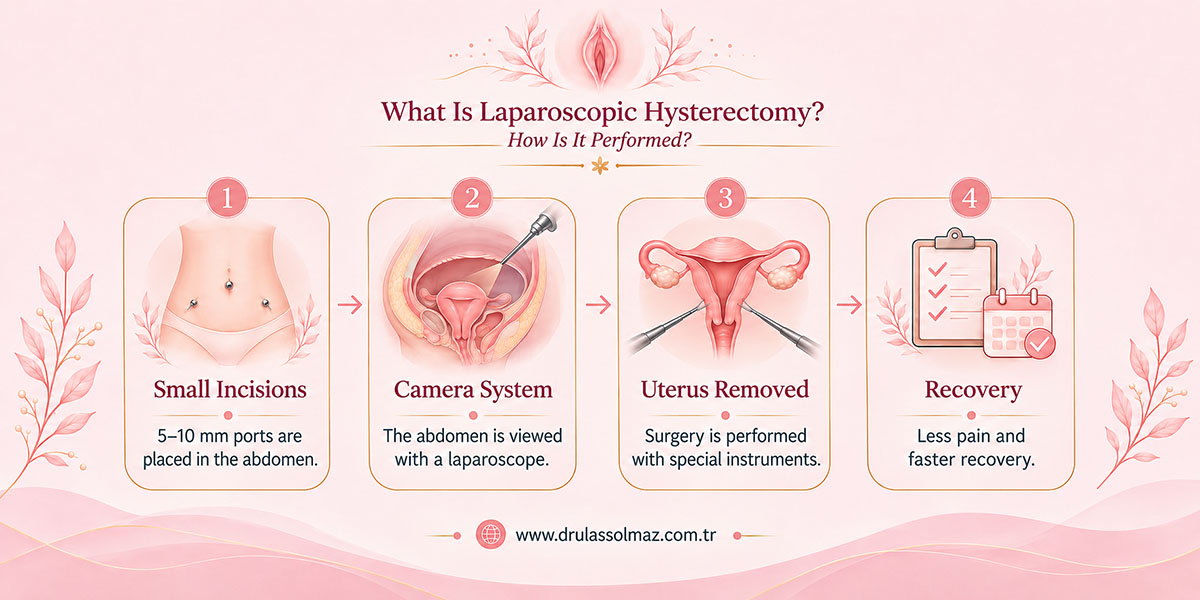
How Is Laparoscopic Hysterectomy Performed?
Laparoscopic hysterectomy is usually performed under general anesthesia.
- Two or three small openings, usually measuring 5–10 mm, are made in the abdominal wall. These openings are called trocar insertion sites.
- A camera system with a light source at its tip, called a laparoscope, is inserted into the abdominal cavity through one of these openings.
- Special surgical instruments required for the operation are introduced through the other openings.
- The uterus is carefully separated from the surrounding tissues and removed according to the surgical plan.
- In cases where necessary, the fallopian tubes and/or ovaries may also be removed during the same procedure.
The approach used for laparoscopic hysterectomy is determined individually for each patient. Therefore, the surgical plan is finalized after the examination and necessary tests.
How Long Does Laparoscopic Hysterectomy Surgery Take?
Although the duration of laparoscopic hysterectomy may vary depending on the patient, the size of the uterus, the presence of adhesions, and any additional procedures, the operation can be completed in approximately 1–2 hours in most cases.
After Surgery
The patient is taken to the hospital room. A hospital stay of 1–2 days is generally planned, and discharge takes place if postoperative assessments are satisfactory.
Recovery After Laparoscopic Hysterectomy
Early recovery after laparoscopic hysterectomy may become noticeable within 1–2 weeks in most patients. Although patients may return to daily activities earlier, returning to work or regaining full physical performance often takes approximately 3–6 weeks.
The recovery process after laparoscopic hysterectomy varies from person to person. Following the doctor’s recommendations directly affects recovery. Strenuous exercise and high-intensity activities are not recommended until full recovery has been achieved.
What Are the Advantages of Laparoscopic Hysterectomy?
When performed using a minimally invasive technique, several advantages may be observed compared with open surgery:
- Faster recovery due to the absence of a large incision
- Reduced risk of infection
- Shorter hospital stay
- Less postoperative pain
- Better cosmetic results (smaller scars)
However, the most important factor is the combination of appropriate patient selection, the correct surgical technique, and an experienced surgical team.
Are There Any Risks Associated With Laparoscopic Hysterectomy?
Laparoscopic hysterectomy is a surgical procedure and, like any surgery, carries certain risks. These risks vary depending on the patient’s general health, previous operations, the type of disease, and the surgical plan. Therefore, an individualized risk assessment should be performed during the medical consultation.
For more detailed information and evaluation regarding laparoscopic hysterectomy, I see patients at my clinic in Izmir.
Frequently Asked Questions (FAQ)
Laparoscopic hysterectomy is performed using a minimally invasive technique through small incisions. In open surgery, a larger incision is made in the abdominal area. Recovery is generally faster with the laparoscopic method.
Because the uterus is removed, menstrual bleeding stops completely.
If the ovaries are preserved, the patient does not enter menopause immediately. However, ovarian function may be affected over time.
After the recovery period is complete, sexual life is not negatively affected in most patients. Sexual intercourse is not recommended during the first few weeks.
Patients who perform light work can generally return within 2–3 weeks. Regaining full physical performance may take 3–6 weeks.
Previous operations, the size of the uterus, and accompanying medical conditions may affect the choice of surgical method.
Because the incisions are very small, scars are generally minimal and become less noticeable over time.
Pain is generally less severe compared with open surgery and can usually be controlled with pain medication.
Light walking is possible during the early recovery period. Patients are generally advised to wait 4–6 weeks before resuming strenuous exercise.
It is a safe surgical method when performed by experienced teams in appropriately selected patients. However, like any operation, it carries certain risks.

What Is Liquid-Based Cytology? Differences from a Pap Smear
Liquid-based cytology (LBC) is a method in which cells collected from the cervix are placed [...]
Devamını okuNov

What Are Lymph Nodes? Why Are They Important in Gynecologic Cancers?
Terms such as lymph node, lymphadenopathy, reactive lymph node, and lymph node involvement found in [...]
Devamını okuOct

What Is Endometrial Thickening? What Causes Thickening of the Uterine Lining?
Endometrial thickening refers to the endometrium, the inner lining of the uterus, appearing thicker than [...]
Devamını okuOct

What Is the Difference Between an Ovarian Cyst and Ovarian Cancer?
An ovarian cyst is a structure that develops inside or on the surface of the [...]
Devamını okuAug

How Should Sexual Intercourse Be After HPV? Common Myths and Facts
HPV (Human Papillomavirus) is one of the most common sexually transmitted infections. A positive HPV [...]
Devamını okuAug

Sexual Life During Cancer Treatment
Sexual life during cancer treatment is a topic that is often left unspoken, yet it [...]
Devamını okuAug

Should You Tell Your Child or Family That You Have Cancer?
Receiving a cancer diagnosis can suddenly change the course of life. In the first days [...]
Devamını okuAug

What Causes Vaginal Itching? How Can Vaginal Itching Be Relieved?
Vaginal itching is a common complaint that can negatively affect daily life. Although it is [...]
Devamını okuJul
