
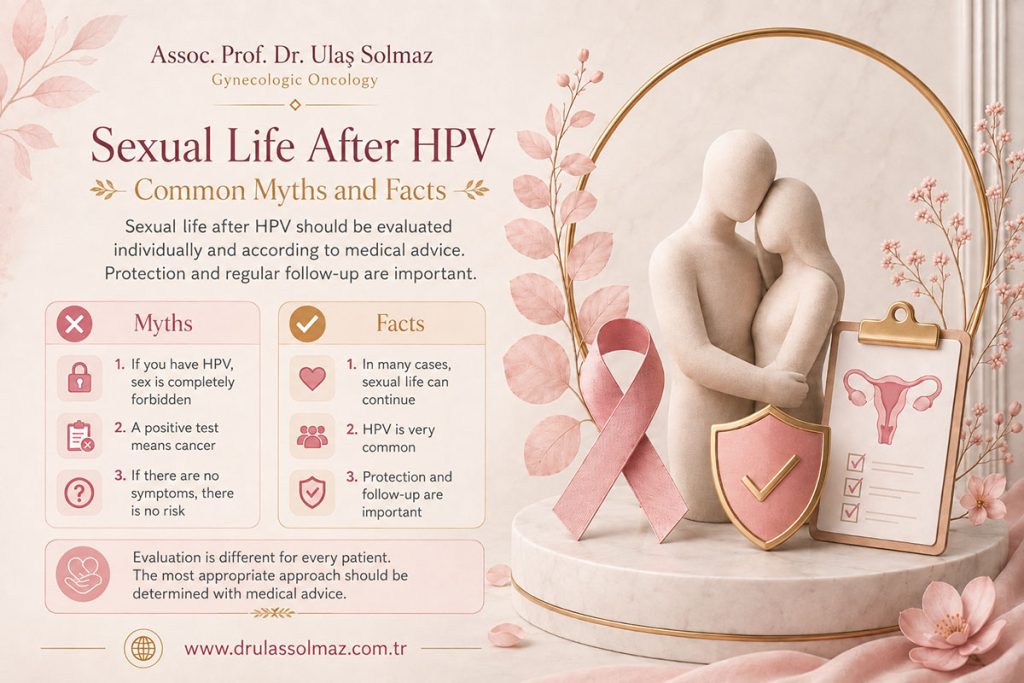
HPV (Human Papillomavirus) is one of the most common sexually transmitted infections. A positive HPV test result may raise important questions not only about health, but also about sexual life and partner relationships.
“Now that I have HPV, should I avoid sexual intercourse?”, “Will I definitely transmit it to my partner?”, “Does HPV positivity mean I have been cheated on?”, “Does a condom fully protect against HPV?”, “Should sexual intercourse be avoided until HPV clears?”
These are among the questions I most frequently hear from my patients after an HPV diagnosis. First of all, I should emphasize the most important point: being HPV positive does not mean that sexual life must come to an end.
In most cases, a normal sexual life can be maintained with accurate information, appropriate protection methods, and regular follow-up.
Can You Have Sexual Intercourse While HPV Positive?
In most cases, the answer to this question can be yes. A positive HPV test alone is not a condition that requires sexual intercourse to be medically and completely prohibited.
HPV is an extremely common virus, and a significant proportion of sexually active people may encounter HPV at some point in their lives. Therefore, HPV positivity alone should not be considered a reason for panic.
At this point, I especially explain the following to my patients: what matters in HPV positivity is taking into account the HPV type, smear result, cervical evaluation, and the follow-up plan recommended by the doctor.
Of course, informing the partner, evaluating protection methods, and not neglecting regular check-ups are important in terms of sexual life. In some special situations, your doctor may recommend temporarily avoiding sexual intercourse.
Is It Necessary to Avoid Sexual Intercourse Until HPV Clears?
My answer to this question is usually no. There is no general medical approach that requires avoiding sexual intercourse for months solely because of HPV positivity.
However, in some cases, it may be necessary to take a temporary break from sexual intercourse. For example, after:
- LEEP,
- conization,
- cervical biopsy,
- genital wart treatment,
- or other surgical procedures involving the cervix,
your doctor may restrict sexual intercourse for a certain period so that the tissues can heal properly.
This restriction is usually not due to HPV itself, but rather to the healing process of the tissue that has undergone a procedure.
Does a Condom Fully Protect Against HPV?
One of the most common misconceptions I encounter about HPV is the belief that condoms prevent HPV transmission 100%. Condoms do not provide complete protection against HPV, but they may reduce the risk of transmission.
A condom may reduce the risk of HPV transmission. However, HPV can also be present on genital skin areas not covered by the condom, so it does not provide full protection. Therefore, the idea that “I use a condom, so HPV transmission is impossible” is not correct.
Nevertheless, condom use may help reduce the likelihood of HPV transmission. It is also important for protection against other sexually transmitted infections.
Especially in new relationships, or when it is not known whether partners have previously been exposed to HPV, condom use may be considered. In couples who have been together for a long time, completely changing sexual life solely because of HPV positivity is usually not necessary.
Is Oral Sex Safe When HPV Is Present?
HPV can also be transmitted to the mouth and throat area. Some high-risk HPV types are associated with oropharyngeal cancers. However, I should especially emphasize that not everyone who is exposed to HPV will develop these diseases.
Using condoms or other barrier methods during oral sexual contact may reduce the risk of transmission; however, it does not eliminate the risk completely.
Can You Have Sexual Intercourse When Genital Warts Are Present?
Active genital warts are important in terms of HPV transmission. When warts are present, close genital contact may increase the likelihood of transmission. In addition, during sexual intercourse, warts may become irritated or bleed due to friction.
During this period, it is important to inform the partner, use barrier methods, and have the lesions evaluated by a physician. Also, the disappearance of warts after treatment does not mean that HPV has completely cleared from the body at the same time.
The 8 Most Common Myths About Sexual Life After HPV
1. “If I have HPV, I can no longer have sexual intercourse.”
This is a false belief. Most HPV-positive individuals can continue their normal sexual life by following the follow-up plan recommended by their doctor.
2. “If HPV is detected, my partner must have cheated on me.”
This belief is incorrect. HPV can remain in the body for a long time without causing symptoms. Therefore, it is often not possible to determine when or from whom the infection was acquired.
I especially explain this to my patients: HPV positivity alone is not an indicator of infidelity.
3. “A condom protects against HPV 100%.”
False. A condom may reduce the risk of transmission, but it does not eliminate it completely.
4. “If I am HPV positive, I have cancer.”
False. HPV infection and cancer are not the same thing. What matters in terms of cervical cancer is especially the persistence of high-risk HPV infection and the cellular changes it may cause over time.
5. “There is no point in getting vaccinated after testing positive for HPV.”
False. The HPV vaccine does not treat an existing HPV infection. However, it may provide protection against HPV types that the person has not previously encountered and that are covered by the vaccine.
Therefore, having previously encountered HPV does not necessarily mean that the vaccine is unnecessary. The HPV vaccine may be considered in individuals of appropriate age and under suitable conditions. The vaccine is not only for women; men may also benefit from HPV vaccination.
6. “Sexual intercourse is prohibited until I become HPV negative.”
This is generally incorrect. HPV positivity alone does not require avoiding sexual intercourse for a long time.
7. “If my partner has no symptoms, they do not have HPV.”
False. HPV often causes no symptoms. Therefore, the absence of symptoms does not mean that a person has never been exposed to HPV.
8. “If my wart has disappeared, HPV has completely cleared.”
This is not always true. The disappearance of a wart does not show that the virus has completely disappeared at the same time.
Is It Necessary to Tell a New Partner About HPV Positivity?
This question is not only a medical issue, but also a personal and relationship-related matter. Therefore, I recommend that my patients approach this issue not with guilt or panic, but with accurate information.
Although HPV is extremely common in society, many people may feel anxious about sharing an HPV diagnosis with a new partner. First, the following point should be known: HPV positivity does not make a judgment about a person’s sexual behavior or loyalty.
When there is a new sexual partner, openly discussing HPV status may help the partner become informed and allow protection options to be evaluated together.
For example, the conversation may be approached as follows:
“HPV positivity was detected in my HPV test. HPV is a very common virus, and it is often not possible to determine when it was acquired. I am attending the check-ups recommended by my doctor. We can also get information together about protection and HPV vaccination.”
This approach can help turn HPV from a subject of blame or shame into a health issue that can be managed together.
What Should Be Done If There Is a New Partner?
An HPV diagnosis may cause anxiety when starting a new relationship. The aim here is not to create fear, but to act consciously.
In a new relationship, an appropriate approach would be:
- establishing open communication with the partner,
- evaluating barrier methods such as condoms,
- considering HPV vaccination for suitable individuals,
- and not neglecting the recommended check-ups for current HPV positivity.
It should not be forgotten that HPV is extremely common in society. With accurate information, regular follow-up, evaluation of protection methods, and open communication, the process after an HPV diagnosis can be managed in a healthier way.
