
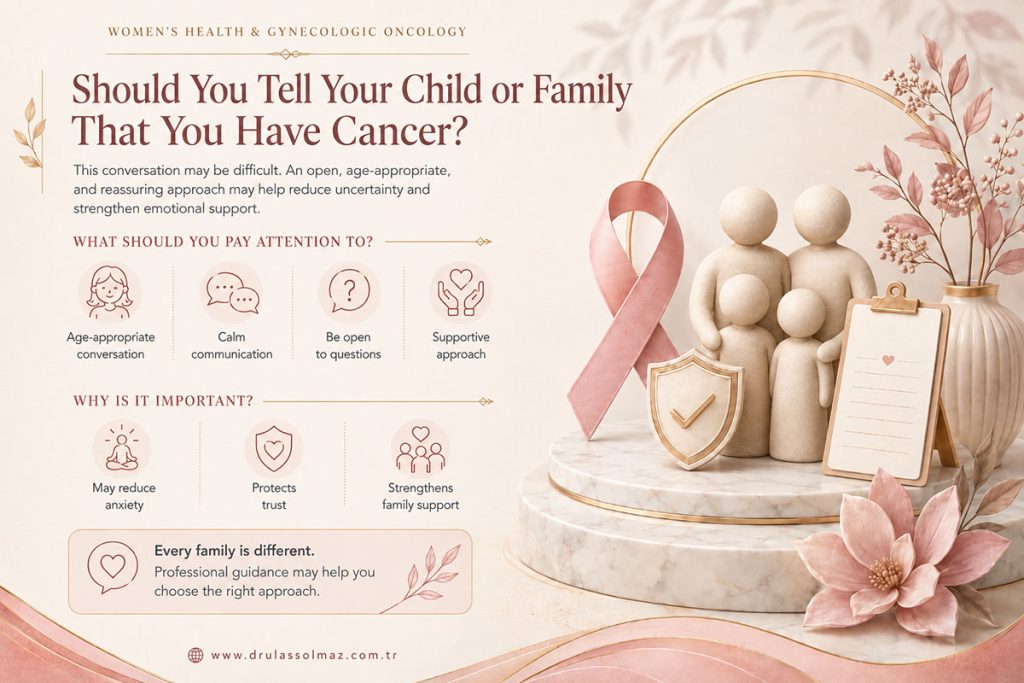
Receiving a cancer diagnosis can suddenly change the course of life. In the first days after learning the diagnosis, many questions may run through your mind. How will the treatment proceed? Will I recover? Will I need surgery? Will I receive chemotherapy?
However, for many patients, there are even more difficult questions:
- How will I tell my child?
- How can I share this news with my mother, father or spouse without upsetting them?
One important fact shown by studies in psychology and oncology is that open communication, when done with love, honesty and in an age-appropriate way, is much more healing than uncertainty and silence.
In this article, I will try to explain the right time, the right words and the healthiest approach after a cancer diagnosis.
Is Hiding a Cancer Diagnosis Really Protective?
The first instinct is often to protect our loved ones. However, children and family members often sense what is left unsaid. Hospital visits, conversations at home, physical changes and emotional ups and downs do not go unnoticed.
Children who do not know the truth may create scenarios in their imagination that are even more frightening than reality. For this reason, experts recommend sharing the diagnosis in an age-appropriate way rather than hiding it completely.
Children Want to Know the Truth
Children’s greatest fear is often not the word “cancer” itself. Their real fears are losing their mother or father, being left alone, thinking that they are to blame, or believing that the disease is contagious.
Open communication is not only about giving information; it is also one of the most effective ways to reduce a child’s anxiety.
How Should You Tell Your Child That You Have Cancer?
You can explain your cancer diagnosis according to your child’s age group:
- Ages 3–6: Use simple, short and reassuring words. “The doctors will treat mommy’s/daddy’s illness. My love for you will never change.”
- Ages 7–12: Answer their questions honestly. Make sure to tell them that cancer is not contagious and that it is not their fault.
- Teenagers: Talk about the treatment process openly and give them space to express their feelings.
How Should You Tell Older Family Members?
The treatment process is often not a journey that can be walked alone. Your loved ones need to know your situation so that they can support you.
The best approach is to talk in a calm environment, with an honest but hopeful tone.
Protecting Hope Does Not Mean Hiding the Truth
Instead of hiding the facts, share the treatment plan and the hopeful aspects of the process.
“Yes, I have been diagnosed with cancer. This will not be easy, but we have effective treatment options and we will manage this process together.”
Sentences to Avoid When Talking
Instead of saying “There is nothing wrong with me,” “Let’s not talk about it,” or “Don’t cry,” it is better to use reassuring expressions such as:
“You can always ask me your questions.”
“We will face this together.”
“It is normal to feel scared.”
Children Are Stronger Than We Think
Research shows that children are most affected by uncertainty. Children who are informed in an age-appropriate way may adapt to the treatment process in a healthier way.
Getting Psychological Support Is Not a Sign of Weakness
Especially in families with young children or during long treatment processes, receiving support from a psychologist or psycho-oncology specialist can provide important benefits for both the patient and the family.
The Most Important Thing I Tell My Patients as a Physician
Cancer is now a disease that can be treated in many cases or kept under control for many years. The focus of the conversation should not only be the illness, but also the treatment plan, hope and facing the process together.
“This may be a difficult process. But we will walk this road together. I love you, and you are not alone.”
Conclusion
Sharing a cancer diagnosis is not easy. However, conversations held at the right time, with the right words and a reassuring approach can help both the patient and the family adapt to this process more easily.
Open communication, love and trust are among the strongest forms of support during this journey.
Assoc. Prof. Dr. Ulaş Solmaz’s Note
One of the most common questions we hear during consultations with patients diagnosed with gynecological cancer is, “How will I explain this to my child?”
Honest, age-appropriate and hopeful communication helps both the patient and the family manage this process in a healthier way.
Treatment is not only about surgeries and medications; psychological well-being and family support are also essential parts of treatment.
Frequently Asked Questions (FAQ)
Should I Tell My Child That I Have Cancer?
Yes. Experts recommend informing children honestly and in a way that is appropriate for their age.
Is It Right to Hide a Cancer Diagnosis From Children?
Instead of hiding it completely, it is healthier to explain the situation in an age-appropriate way.
Can Cancer Spread to Children?
No. Cancer is not contagious.
What If My Child Asks, “Are You Going to Die?”
Adopt a hopeful approach without denying the truth, and explain that you have a treatment plan.
At What Age Can Cancer Be Explained to Children?
Age-appropriate explanations can be made even during the preschool period.
What Should I Do If My Child Gets Upset?
Allow them to express their feelings, listen to them and seek professional support if necessary.
How Should Older Family Members Be Told?
The conversation should take place in a calm environment, using an honest and hopeful tone.
Is Psychological Support Necessary?
For some families, it can be very helpful.
What Is the Most Important Message?
“This may be a difficult process. But we are not alone. We have treatment options, and we will walk this road together.”
