
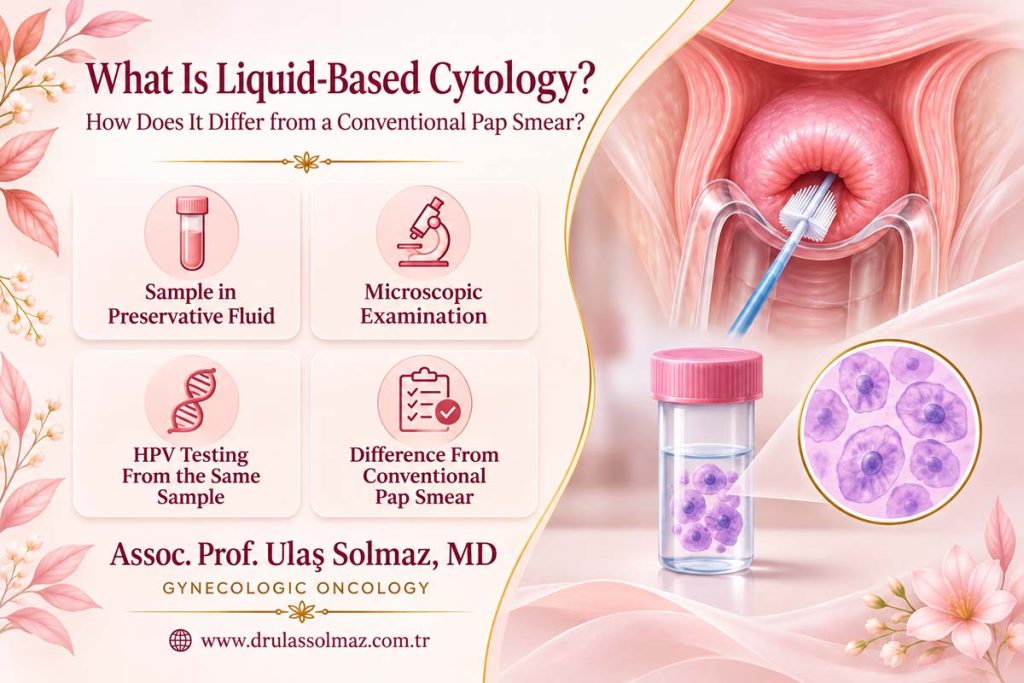
Liquid-based cytology (LBC) is a method in which cells collected from the cervix are placed in a special preservative solution and sent to a laboratory for examination. It is one of the methods used to perform the Pap smear test, particularly for cervical cancer screening and the detection of precancerous cellular changes.
The main difference from a conventional Pap smear is how the collected cell samples are prepared in the laboratory. Systems such as ThinPrep and NOVAprep are examples of liquid-based cytology methods.
How Is Liquid-Based Cytology Performed?
During the procedure, a cell sample is collected from the cervix using a small brush. In a conventional Pap smear, the cells are spread directly onto a glass slide, whereas in liquid-based cytology, they are transferred into a special preservative solution.
The sample is processed in the laboratory to reduce the interference caused by blood, mucus, and inflammatory debris. The cells are then prepared for microscopic examination. From the patient’s perspective, the sample collection procedure is largely the same as a conventional Pap smear test.
What Are the Advantages of Liquid-Based Cytology?
Liquid-based cytology offers several potential advantages:
- More uniform cell preparation: It helps prepare cells in a more evenly distributed manner and may reduce interference from materials that make microscopic examination difficult.
- Fewer unsatisfactory samples: Some studies have shown that liquid-based cytology may reduce the number of samples that are unsuitable for evaluation compared with conventional Pap smear methods.
- Additional testing from the same sample: With compatible sample collection and testing systems, the remaining material can be used for HPV (human papillomavirus) testing and HPV genotyping.
However, liquid-based cytology cannot be considered more diagnostically accurate than conventional Pap smears in every situation. Both methods are used to detect abnormal cellular changes in the cervix.
What Is the Difference Between Liquid-Based Cytology and a Conventional Pap Smear?
Both methods have the same purpose: to detect abnormal cellular changes in the cervix. In a conventional Pap smear, cells are spread directly onto a glass slide. In liquid-based cytology, the cells are first transferred into a preservative solution and then processed in the laboratory for microscopic examination.
Liquid-based cytology is not a separate cancer test; it is an alternative method of preparing cervical cell samples for Pap smear examination.
If abnormal cellular changes are detected, further examinations may be planned based on the patient’s HPV status and previous screening results.
References
- Liquid Compared With Conventional Cervical Cytology: A Systematic Review and Meta-analysis
- Liquid-Based Cytology and Human Papillomavirus Testing to Screen for Cervical Cancer: A Systematic Review
- NICE – Guidance on the Use of Liquid-Based Cytology for Cervical Screening
- CDC – HPV-Associated Cancers and Precancers
