
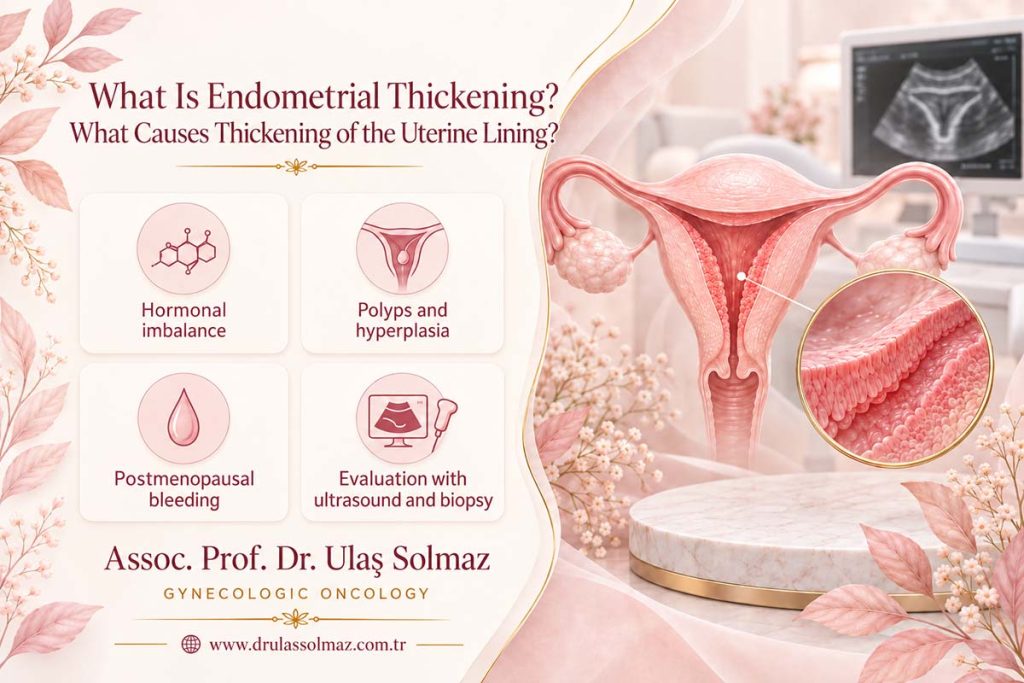
Endometrial thickening refers to the endometrium, the inner lining of the uterus, appearing thicker than expected on ultrasound evaluation. This condition is commonly described as thickening of the uterine lining.
The endometrium changes throughout the menstrual cycle under the influence of hormones. It thickens during the cycle and is shed with menstrual bleeding if pregnancy does not occur. For this reason, endometrial thickness is not fixed in women who still have menstrual periods; it may vary depending on the phase of the cycle.
However, in some cases, thickening of the uterine lining cannot be explained only by normal cyclic changes. Hormonal imbalance, polyps, endometrial hyperplasia or, more rarely, endometrial cancer may need to be considered.
Approximate Endometrial Thickness According to the Menstrual Cycle
Endometrial thickness may vary depending on a woman’s age, the phase of the menstrual cycle, menopausal status and whether abnormal bleeding is present. Therefore, it is not always accurate to define a single “normal value.”
The following values are approximate ranges for general information:
| Phase | Approximate Endometrial Thickness |
| Menstrual phase | Approximately 2–4 mm |
| Early phase after menstruation | Approximately 5–7 mm |
| Ovulation period and after | Approximately 8–14 mm |
| Postmenopausal period | The endometrium is expected to be thin; especially if bleeding is present, the 4 mm threshold should be carefully evaluated |
These values alone do not establish a diagnosis. In women who still have menstrual periods, the thickness of the uterine lining may vary depending on the day of the menstrual cycle when the measurement is performed.
For this reason, endometrial thickness reported on ultrasound should be evaluated together with the patient’s age, symptoms, menstrual pattern, menopausal status, medications used and ultrasound findings.
Evaluation Is Different Before and After Menopause
Before menopause, endometrial thickness naturally changes throughout the menstrual cycle. It may appear thinner after menstruation and thicker around ovulation or before the next menstrual period.
Therefore, a thick-looking endometrium in a woman of reproductive age does not always indicate a serious condition. However, irregular bleeding, bleeding between periods, prolonged menstrual bleeding or the presence of risk factors may require closer evaluation.
After menopause, the situation is different. As estrogen levels decrease, the endometrium is expected to become thin.
Endometrial thickness should be evaluated more carefully, especially in the presence of postmenopausal vaginal bleeding. In a woman with postmenopausal bleeding, an endometrial thickness of 4 mm or less on transvaginal ultrasound is generally considered low risk. However, if bleeding continues, recurs or additional risk factors are present, further evaluation may be needed.
For this reason, decisions in postmenopausal bleeding should not be based only on the millimeter measurement. The patient’s overall clinical condition should also be taken into account.
What Causes Endometrial Thickening?
One of the most important causes of thickening of the uterine lining is an imbalance between estrogen and progesterone hormones. Estrogen causes the endometrium to thicken, while progesterone helps the tissue mature and shed in an organized way.
Estrogen that is not balanced by progesterone may cause the endometrium to thicken more than expected.
Possible causes of endometrial thickening include:
- Hormonal imbalances
- Ovulation disorders
- Polycystic ovary syndrome
- Obesity
- Diabetes
- Perimenopausal period
- Hormone therapy after menopause
- Use of certain medications such as tamoxifen
- Endometrial polyps
- Endometrial hyperplasia
Not all of these causes carry the same level of risk. Therefore, when thickening of the uterine lining is detected, the main goal is to understand the underlying cause correctly.
What Are the Symptoms of Thickening of the Uterine Lining?
Endometrial thickening may sometimes be detected incidentally during a routine ultrasound without causing any symptoms. In other patients, it may present with abnormal bleeding patterns.
Possible symptoms include:
- Irregular menstrual bleeding
- Heavier-than-usual menstrual bleeding
- Prolonged menstrual bleeding
- Bleeding between periods
- Spotting
- Delayed periods
- Postmenopausal vaginal bleeding
- Pelvic or lower abdominal pain
Especially postmenopausal vaginal bleeding should always be taken seriously. It does not always mean cancer, but it does require gynecologic evaluation.
Does Endometrial Thickening Mean Cancer?
Endometrial thickening alone is not a diagnosis of cancer. In many patients, the uterine lining may become thick due to hormonal changes, polyps or benign causes.
However, in some cases, endometrial hyperplasia or atypical hyperplasia, which may be considered a precancerous condition, can be detected. Therefore, further evaluation may be required, especially in the presence of postmenopausal bleeding, irregular endometrial appearance, marked thickening or risk factors.
The important point is not to consider every case of thickening of the uterine lining as cancer. At the same time, it should not be ignored completely, especially in patients with risk factors.
Is an Endometrial Polyp the Same as Thickening of the Uterine Lining?
An endometrial polyp and thickening of the uterine lining are not the same. An endometrial polyp is a localized tissue growth arising from the inner lining of the uterus. On ultrasound, it may sometimes appear similar to uterine lining thickening or may cause the endometrium to look irregular.
For this reason, ultrasound alone may not always clearly distinguish between the two. In such cases, hysteroscopy may be needed for a more detailed evaluation of the uterine cavity.
How Is It Diagnosed?
The first method used in the evaluation of endometrial thickening is usually transvaginal ultrasound. With ultrasound, endometrial thickness is measured and the regularity or irregularity of the uterine lining is assessed.
However, ultrasound does not always provide a definitive diagnosis. In suspicious cases, a tissue sample from the uterine lining may be required.
Diagnostic methods may include:
- Transvaginal ultrasound
- Endometrial biopsy
- Sampling from the uterine lining
- Hysteroscopy
- Pathological examination
A definitive diagnosis is often made after the tissue sample is examined by pathology.
When May Biopsy or Hysteroscopy Be Needed?
A biopsy is not required in every case of endometrial thickening. However, in some situations, sampling from the uterine lining may be necessary.
Biopsy or hysteroscopy may be considered in the following situations:
- Postmenopausal vaginal bleeding
- Endometrium thicker than expected after menopause
- Irregular or heavy menstrual bleeding
- Prolonged menstrual bleeding
- Irregular endometrial appearance on ultrasound
- Suspicion of a polyp
- Suspicion of endometrial hyperplasia
- Presence of risk factors such as obesity, diabetes or tamoxifen use
- Persistent bleeding despite treatment
This evaluation should be individualized. The same endometrial thickness may not mean the same thing in two patients of different ages and clinical backgrounds.
How Is Endometrial Thickening Treated?
Treatment depends on the underlying cause of the thickened uterine lining. The same treatment is not applied to every patient.
In some patients, follow-up may be sufficient. In others, hormonal treatments, progesterone-containing medications or a hormonal intrauterine device may be used. If a polyp is detected, it may need to be removed hysteroscopically.
If endometrial hyperplasia is diagnosed, the treatment plan is determined according to the type of hyperplasia, whether atypical cells are present, the patient’s age, fertility wishes and cancer risk. In suspicious or high-risk situations, evaluation by a gynecologic oncology specialist may be important.
When Should You See a Doctor?
Gynecologic evaluation should not be delayed in the following situations:
- Postmenopausal vaginal bleeding
- Recurrent bleeding between periods
- Heavier-than-usual menstrual bleeding
- Prolonged menstrual bleeding
- Increased endometrial thickness reported on ultrasound
- Suspicion of an intrauterine polyp or hyperplasia
- Bleeding while using tamoxifen
- Presence of risk factors such as obesity, diabetes or a family history of cancer
Endometrial thickening is often not a condition to fear on its own. However, it should be interpreted correctly. Especially after menopause, the thickness of the uterine lining becomes more important when evaluated together with bleeding symptoms. Therefore, when increased endometrial thickness is seen on ultrasound, the most appropriate approach is to evaluate the patient’s age, symptoms, menopausal status and risk factors together.
This content is for general informational purposes only. Endometrial thickening, bleeding symptoms and ultrasound findings should be evaluated individually for each patient.
References
- ACOG – The Role of Transvaginal Ultrasonography in Evaluating the Endometrium of Women With Postmenopausal Bleeding
- ACOG – Endometrial Hyperplasia
- PubMed – Ultrasonography of Endometrium
- PubMed – Endometrial Biopsy: Indications, Techniques and Recommendations
