
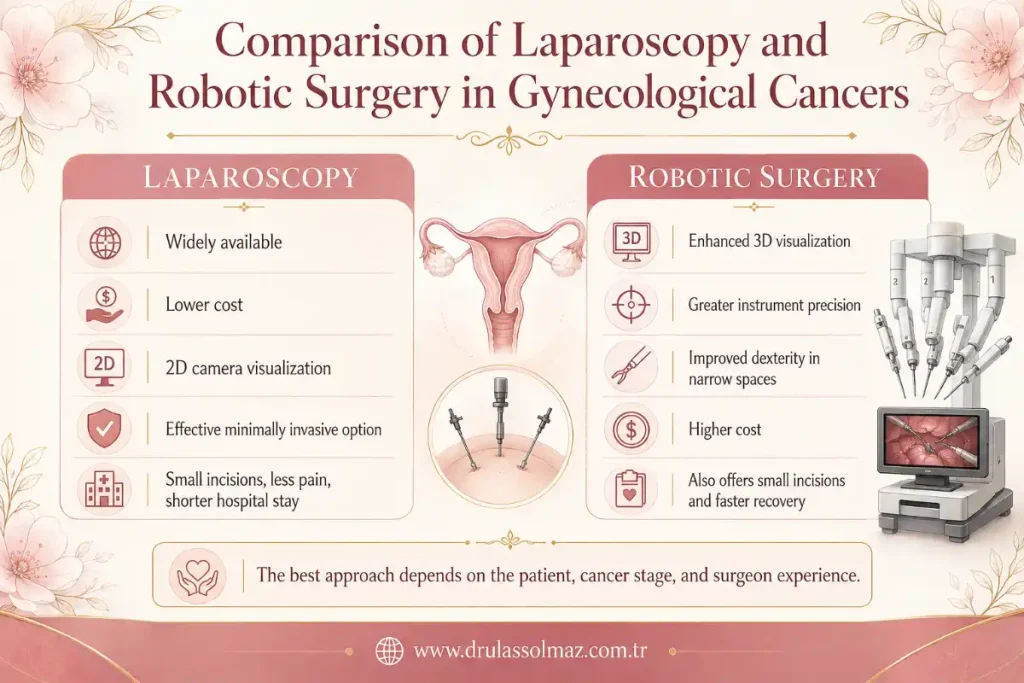
Both laparoscopy and robotic surgery are minimally invasive surgical methods. In other words, these procedures are performed through small incisions instead of a large abdominal cut. The aim is to treat the cancer effectively while offering the patient a more comfortable recovery process.
- Laparoscopy: The surgeon performs the operation using a camera and long surgical instruments while viewing the surgical field on a monitor.
- Robotic surgery: The surgeon controls robotic arms from a special console. The camera provides a three-dimensional image, and the system allows highly precise movements.
In Which Diseases Can They Be Used?
Both methods may be used in selected patients with gynecological cancers, including:
- Endometrial cancer, also known as uterine cancer,
- Cervical cancer in suitable early-stage cases,
- Ovarian cancer in early-stage or carefully selected cases.
The aim is to perform both diagnostic procedures, such as surgical staging, and therapeutic procedures, such as removal of cancerous tissue, with minimal tissue trauma.
What Are the Differences Between Laparoscopy and Robotic Surgery?
The main differences between laparoscopy and robotic surgery can be summarized as follows:
- Image quality: Laparoscopy provides a two-dimensional image, while robotic surgery provides a high-resolution three-dimensional image.
- Instrument precision: Laparoscopic instruments have a limited range of movement, while robotic instruments offer greater flexibility and a wider range of motion.
- Tremor control: In laparoscopy, the surgeon’s hand movements are directly reflected. In robotic surgery, the system filters out hand tremor.
- Ergonomics: Laparoscopy may be physically demanding during long operations, while robotic surgery allows the surgeon to operate while seated at a console.
- Access and visualization: The robotic system may provide easier access and better visualization in deep areas of the pelvis.
- Cost: Robotic surgery is usually more expensive.
Is There a Difference in Oncological Outcomes?
International guidelines, including ESGO, NCCN and ACOG, indicate that there is no significant difference between robotic surgery and laparoscopy in terms of oncological safety and treatment outcomes in appropriately selected patients.
In other words, regardless of which method is used, the most important factors are correct patient selection and the experience of the surgeon.
What Are the Differences for Patients?
Both methods offer important advantages compared with open surgery:
- Less postoperative pain due to smaller incisions,
- Shorter hospital stay,
- Less blood loss,
- Lower risk of infection,
- Earlier mobilization,
- Better cosmetic results.
Recovery may be slightly faster with robotic surgery in some patients. Robotic surgery may also offer certain technical advantages, especially in patients with obesity or in operations involving narrow pelvic areas.
Are There Any Disadvantages?
The disadvantages are mostly related to robotic surgery:
- Higher cost,
- Requirement for advanced technical infrastructure,
- Limited availability in some medical centers,
- Longer preparation and setup time before surgery.
Laparoscopic surgery, on the other hand, is more widely available and accessible.
Which Method Is Suitable for Me?
This decision should be made by a gynecologic oncology surgeon after evaluating:
- The type and stage of the cancer,
- The patient’s general health condition,
- Previous surgical history,
- The technical infrastructure of the surgical center,
- The surgeon’s experience with each method.
In summary, both laparoscopy and robotic surgery can provide important advantages in gynecological cancer surgery. These methods may offer greater comfort for patients and increased precision for surgeons. However, the most important factor is not only the technology used, but also correct patient selection and treatment by an experienced surgical team.
