
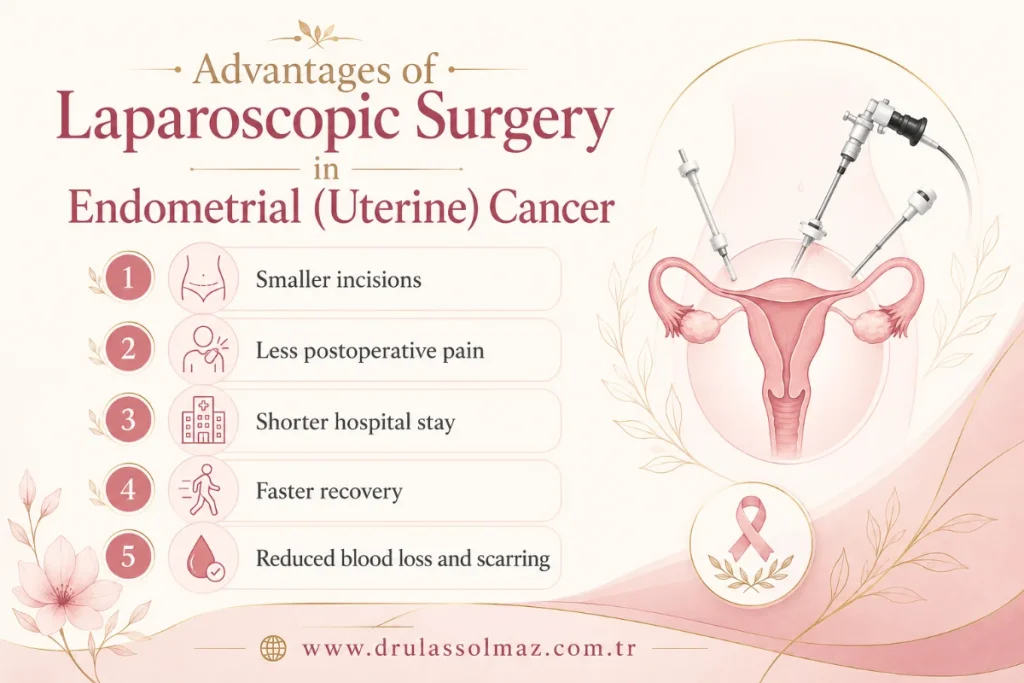
Laparoscopic surgery is one of the surgical methods used in the treatment of endometrial cancer, also known as uterine cancer. In this article, I explain the advantages of laparoscopic surgery in endometrial cancer compared with other surgical approaches.
What Is Laparoscopic Surgery?
Laparoscopic surgery is a minimally invasive surgical technique, also commonly known as keyhole surgery. It is performed through 3–4 small incisions in the abdomen with the help of a camera and special surgical instruments. The surgical area is displayed on a monitor in a magnified view, allowing the surgeon to perform the procedure with precision.
Can Laparoscopy Be Used in Endometrial (Uterine) Cancer?
Today, laparoscopic surgery can be safely performed in selected patients with early-stage endometrial cancer. During surgery, the following procedures are usually performed:
- Removal of the uterus, known as hysterectomy,
- Removal of the ovaries and fallopian tubes, known as bilateral salpingo-oophorectomy,
- Removal of pelvic and para-aortic lymph nodes when necessary,
- Collection of a peritoneal washing sample.
All of these procedures can be performed with a minimally invasive approach, without the need for a large abdominal incision.
For more detailed information about uterine cancer, you can read my article “What Is Endometrial (Uterine) Cancer? Symptoms and Treatment.”
What Are the Advantages of Laparoscopic Surgery?
Laparoscopic surgery offers several advantages for patients:
- Small incisions and minimal scarring: The operation is performed through a few small incisions in the lower abdomen, so the surgical scars are usually less visible.
- Less postoperative pain: Since there is less tissue trauma compared with open surgery, postoperative pain is usually milder.
- Shorter hospital stay: Patients can usually be discharged within 1–2 days.
- Faster recovery: Patients can often start walking within a short time and return to daily life within 1–2 weeks.
- Less blood loss.
- Lower risk of infection.
- Better cosmetic results.
Are the Oncological Outcomes the Same as Open Surgery?
International studies and clinical guidelines, including NCCN and ESGO guidelines, have shown that laparoscopic surgery can be as safe as open surgery in appropriately selected patients with early-stage endometrial cancer. In other words, laparoscopy not only offers a more comfortable recovery process, but it can also provide comparable cancer treatment outcomes when performed by experienced surgical teams.
Who Is Not Suitable for Laparoscopic Surgery?
Laparoscopic surgery may not be suitable for every patient. Open surgery may be preferred in the following situations:
- Advanced-stage cancers, especially when there is spread to the peritoneum, the lining of the abdominal cavity,
- Patients with severe obesity, due to technical surgical difficulty,
- Patients who have had multiple previous abdominal surgeries, especially if there are dense adhesions.
In these cases, open surgery may be a safer and more appropriate option.
What Is the Recovery Process After Surgery?
Patients can usually stand up and walk a few hours after laparoscopic surgery. Most patients are discharged within 1–2 days. After about one week of rest at home, many patients can gradually return to their normal daily activities.
Pain is usually much milder compared with open surgery. Because the incision sites are small, the risk of wound infection and incisional hernia is also lower.
What Is the Difference Between Robotic Surgery and Laparoscopic Surgery?
Robotic surgery is an advanced form of laparoscopic surgery. In this method, the surgeon controls robotic arms through a special console. Robotic surgery can provide greater precision, especially in narrow surgical areas such as the pelvis.
However, robotic surgery is more expensive and may not be available in every medical center. Laparoscopic surgery remains a safe, effective and widely used option in the treatment of selected patients with endometrial cancer.
When performed by experienced surgical teams, laparoscopic surgery can offer cancer treatment outcomes comparable to open surgery while providing patients with a faster and more comfortable recovery process.
